USS Nimitz Tic Tac Encounter
Navy pilots from USS Nimitz encounter a white tic-tac shaped object performing impossible maneuvers off the coast of San Diego. FLIR video later declassified.
Videos
Background
In November 2004, radar and weapons systems aboard USS Princeton tracked anomalous objects off the coast of Southern California over several days. The USS Nimitz Tic Tac Encounter involved trained military pilots witnessing an unexplained oval-shaped object with capabilities beyond known technology.
The Incident
Radar and weapons systems aboard USS Princeton tracked anomalous objects off the coast of Southern California over several days.
On November 14, Commander David Fravor and Lt. Commander Alex Dietrich were dispatched in their F/A-18 Super Hornets to intercept.
Witness Accounts
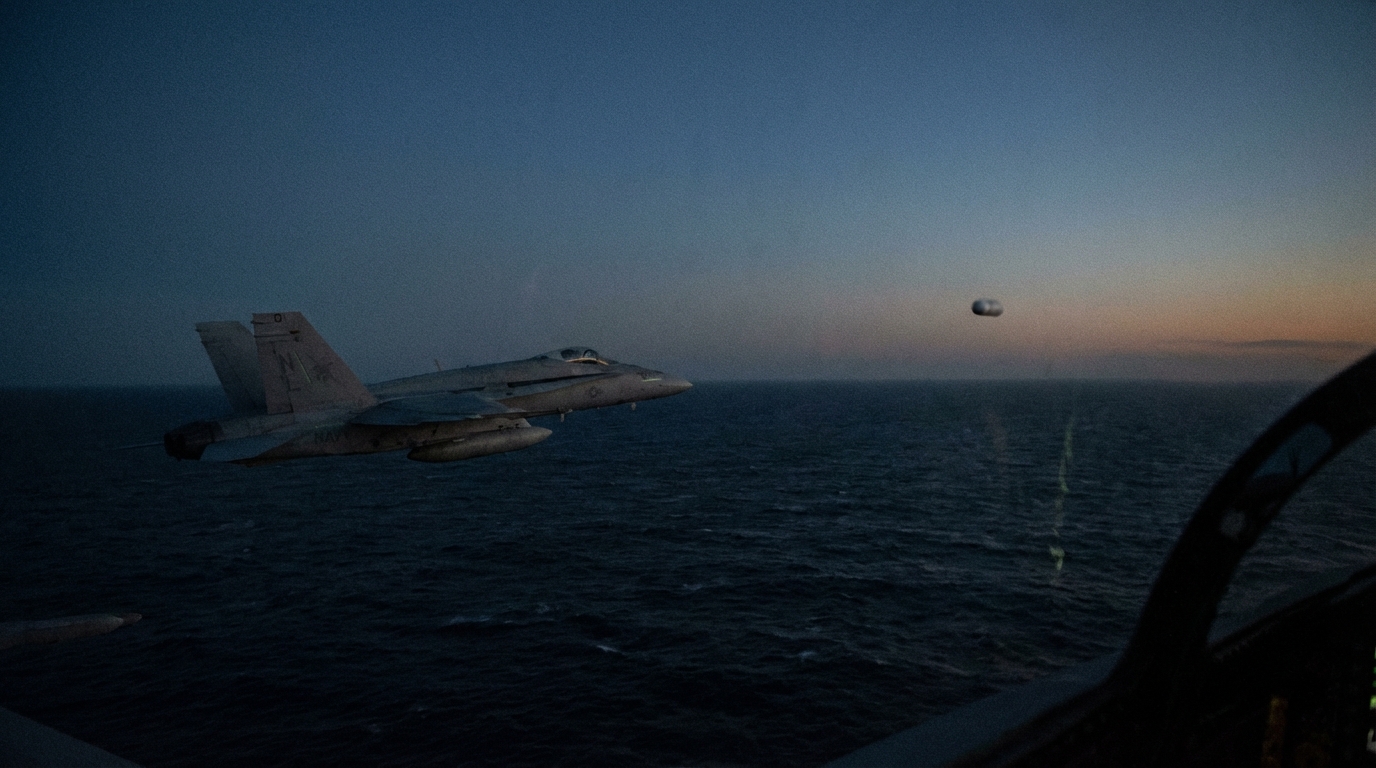
At low altitude, Fravor observed a white, oval-shaped object — approximately 40 feet long, with no wings, visible propulsion, or exhaust — hovering above churning water.
- As Fravor turned his aircraft toward the object, it accelerated extremely rapidly and disappeared.
- Seconds later it was reacquired on Princeton's radar 60 miles away.
Investigation
An infrared camera aboard a second fighter recorded the FLIR1 video.
The video was released publicly in 2017 alongside the New York Times article on AATIP.
Significance
The incident is regarded as one of the best-documented military UAP cases.
- Multiple sensors: radar, IR, visual
- Witnesses: trained military pilots
- Object performance: unexplained by current technology
Elizondo's Account
In Imminent, Elizondo describes the Nimitz encounter as a foundational case for the AATIP program. He explains that the incident led to the systematic development of the Five Observables framework — the analytical tool AATIP used to evaluate UAP capabilities: (1) anti-gravity lift, (2) sudden and instantaneous acceleration, (3) hypersonic velocities without signatures, (4) low observability or cloaking, and (5) trans-medium travel. Elizondo notes that the encounter data was later selected as one of three videos submitted for official declassification via the DOPSR process, alongside the GoFast and Gimbal footage.
Significance
The Tic Tac encounter marked a turning point in UAP credibility because it combined multiple independent sensor systems — radar, infrared targeting pods, and visual observation — all recording the same object displaying capabilities that defied known physics. The witnesses were active-duty Navy pilots with no incentive to fabricate, and the encounter was tracked by the USS Princeton's advanced Aegis radar system. This convergence of sensor data and credible testimony became the catalyst for modern UAP transparency.